The Importance of Safe and Secure Storage in High-Volume Warehousing
Introduction
High-volume warehousing is one of the most operationally demanding environments in the entire supply chain. When a facility is processing thousands of inbound and outbound movements every day, managing tens of thousands of SKUs across multiple storage configurations, and coordinating the activities of large workforces alongside powered handling equipment, the margin for error at every stage is narrow. The consequences of getting it wrong extend far beyond a single misplaced pallet or an unlocked storage door. They reach into product integrity, employee safety, regulatory compliance, financial loss, and ultimately customer trust.
Safe and secure storage in high-volume warehousing is not a single policy or a piece of technology. It is a comprehensive operational discipline that encompasses physical infrastructure design, equipment standards, workforce training, access control systems, inventory management protocols, fire and environmental safety measures, and the organizational culture that binds all of these elements together into a coherent and consistently applied framework.
Businesses that invest seriously in this discipline protect far more than the physical goods stored in their warehouses. They protect the continuity of their supply chains, the reliability of their customer commitments, the welfare of their employees, and the financial integrity of their operations. Those that treat safe and secure storage as a compliance checkbox rather than an operational priority invariably discover the cost of that approach through incidents, losses, and disruptions that were entirely preventable.
At Ursa Service, safe and secure warehousing is a foundational commitment that runs through every aspect of how we design, operate, and continuously improve our storage facilities. This blog examines in depth why safe and secure storage matters so profoundly in high-volume warehousing and what excellence in this area looks like in practice.
1. The Scale and Complexity of High-Volume Warehousing Risk
1.1 Why High-Volume Environments Create Heightened Risk
The risk profile of a high-volume warehouse is categorically different from that of a small or medium-scale storage facility. In a high-volume environment, the sheer density of activity amplifies every potential hazard. Forklifts and other powered handling equipment operate continuously across the facility, sharing space with pedestrian workers in a dynamic environment where collision risk must be actively managed rather than assumed away. Racking systems holding tonnes of goods at height are subjected to frequent contact from handling equipment and must be maintained to standards that prevent structural failure.
The volume and variety of goods stored in a high-volume facility creates complex compatibility and hazard management requirements. Products that must be stored at controlled temperatures sit alongside ambient goods. Flammable materials may be held in proximity to ignition risk sources if segregation is not rigorously managed. High-value goods may be stored alongside commodity items that attract very different levels of security attention. Managing all of these risk dimensions simultaneously across a large and constantly active facility requires systematic discipline that cannot be sustained through informal practices or personal judgment alone.
1.2 The Financial Exposure of Storage Failures
The financial consequences of storage safety and security failures in high-volume operations are substantial and operate across multiple dimensions simultaneously. Direct stock losses from theft, damage, or deterioration represent the most immediately visible cost, but they are far from the only one.
Regulatory penalties for safety violations, particularly in jurisdictions with stringent occupational health and safety and fire safety enforcement, can reach significant levels for warehouses found to be operating below required standards. Insurance claims arising from warehouse incidents typically trigger premium increases at renewal that create ongoing cost impacts well beyond the immediate claim settlement. Business interruption losses arising from a fire, structural failure, or other serious incident in a high-volume warehouse can be catastrophic, with the facility potentially out of operation for months while investigations are completed and damage is remediated.
Customer compensation claims for goods that are damaged, stolen, or deteriorated in storage add further financial exposure. For businesses operating on contractual service level agreements with penalty provisions for product loss or damage, the direct liability from storage failures can be substantial. And the reputational damage from repeated or serious storage incidents can erode customer relationships that took years to build and represent far more long-term commercial value than any single insurance claim can recover.
2. Physical Safety in High-Volume Warehousing
2.1 Racking System Integrity and Inspection
The racking systems in a high-volume warehouse represent one of the most significant structural safety considerations in the entire facility. Standard selective pallet racking can hold several tonnes of goods per bay at heights of ten meters or more. When racking is damaged by forklift impact, incorrectly loaded beyond its rated capacity, or inadequately maintained, the risk of collapse is real and the consequences are potentially fatal for any worker in the vicinity.
Racking safety in high-volume operations requires a multi-layered management approach. Installation by qualified racking specialists to manufacturer specifications and regulatory standards is the foundation. Regular formal inspection by competent racking inspectors, supplemented by ongoing daily visual checks by trained warehouse staff, identifies damage and deterioration before it reaches the point of structural risk. A clear damage reporting protocol that empowers every worker to report racking damage immediately without fear of negative consequences ensures that problems are identified at the earliest possible stage.
Racking protection measures including column guards, end-of-aisle barriers, and floor-mounted deflectors reduce the frequency of forklift contact damage in the highest-risk locations. Load notices clearly displaying the rated capacity of each racking bay prevent overloading that exceeds structural tolerances. And a defined response protocol for damaged racking, including immediate removal of goods from the affected section and exclusion of personnel until inspection and repair or replacement is completed, ensures that identified damage does not create ongoing exposure while repair is awaited.
2.2 Forklift and Materials Handling Equipment Safety
Powered materials handling equipment is the primary source of serious workplace injury in high-volume warehousing environments. Forklifts in particular combine significant weight, limited operator visibility, and operation in environments shared with pedestrian workers in ways that create severe collision and crush hazards that require active management.
Safe equipment operation in high-volume warehouses begins with operator certification. Every person operating a forklift or other powered handling equipment must hold current, appropriate certification for the specific equipment type they are operating. Certification must be renewed at regular intervals and must include practical assessment rather than simply theoretical testing. New operators must complete facility-specific induction that covers the specific hazard profile and traffic management arrangements of the warehouse before operating independently.
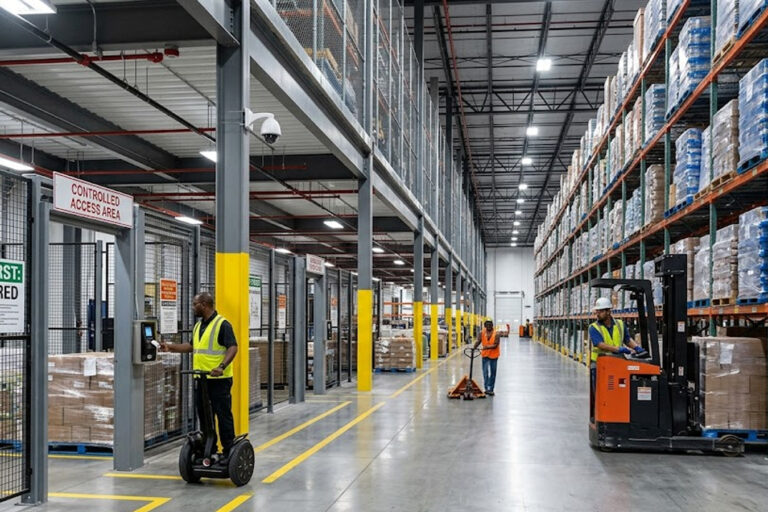
Physical segregation between pedestrian and equipment traffic zones is one of the most impactful safety measures available in warehouse design. Clearly marked and physically delineated pedestrian walkways that provide safe routes between work areas without requiring pedestrians to cross equipment travel lanes dramatically reduce the risk of vehicle and pedestrian collision. Where crossing points are unavoidable, clearly marked crossing zones with appropriate warning systems ensure that both pedestrians and equipment operators are alert to the interaction point.
Pre-operational equipment checks before each shift identify defects including braking problems, hydraulic leaks, warning system failures, and tyre damage that could create safety hazards during operation. A clear out-of-service protocol for defective equipment prevents compromised vehicles from being operated pending repair.
2.3 Working at Height Safety
High-volume warehouses frequently require work at height for stock put-away and retrieval operations, inventory counting, picking from elevated shelf levels, and maintenance activities. Falls from height remain one of the leading causes of serious workplace injury across all industries, and the warehousing environment presents multiple elevated working scenarios that must be managed carefully.
Order picker trucks and mast-mounted elevated work platforms that lift operators to elevated picking positions require specific operator training and regular equipment inspection. Fixed access systems including racking-integrated stairs and platforms for areas requiring frequent elevated access eliminate the need for portable access equipment in these locations. Where portable ladders or elevated work platforms must be used, specific risk assessment, appropriate equipment selection, and supervision requirements apply.
Mezzanine floors and elevated storage platforms represent significant fall hazards where edge protection to regulatory standards must be installed and maintained. Regular inspection of edge protection systems, load-bearing capacity verification for mezzanine floors, and clear load limits posted at access points are all components of an adequate elevated storage safety framework.
2.4 Manual Handling and Ergonomic Safety
Despite the mechanization of many handling activities in high-volume warehouses, manual handling of goods remains a significant component of most warehouse operations, particularly in picking, packing, and value-added service areas. Musculoskeletal injuries from manual handling including back injuries, shoulder strains, and repetitive strain injuries are among the most common and costly workplace injuries in warehousing, generating significant absence, reduced productivity, and workers compensation costs.
Ergonomic warehouse design reduces manual handling injury risk by minimizing the need for heavy lifts, avoiding extreme bending and reaching movements, and positioning frequently handled goods at optimal working heights. Mechanical aids including hand trucks, pallet jacks, and vacuum lift devices reduce the manual effort required for movements that cannot be fully mechanized. Manual handling training that teaches correct lifting technique and posture, combined with rest break schedules that prevent fatigue-related injury risk accumulation, completes an ergonomic safety program appropriate for high-volume operations.
3. Security in High-Volume Warehousing
3.1 The Scale of Warehouse Theft and Its Supply Chain Impact
Warehouse theft represents a significant and persistent challenge for high-volume storage operations worldwide. The combination of large quantities of valuable goods, complex environments where unauthorized activity can be difficult to detect, and the involvement of multiple parties including permanent staff, agency workers, contractors, and visitors creates a security challenge that demands systematic management.
The impact of warehouse theft extends well beyond the direct value of stolen goods. Inventory discrepancies caused by theft undermine the accuracy of stock records, creating ripple effects through procurement, production planning, and customer order management. Customs authorities take a serious view of inventory losses in bonded warehouses, creating regulatory exposure for facilities that cannot demonstrate adequate security controls. Insurance coverage for warehousing operations typically includes security standard requirements, and facilities that fail to maintain those standards may find their coverage voided precisely when a significant theft event occurs.
3.2 Physical Security Infrastructure
The physical security infrastructure of a high-volume warehouse forms the first line of defense against unauthorized access and theft. Perimeter security including fencing, controlled vehicle entry points, and adequate external lighting establishes a secure boundary around the facility. Building security including robust door and loading dock security, window protection where applicable, and roof access prevention addresses the building envelope.
Access control systems that require individual credential verification for entry to the warehouse and to specific zones within it, combined with visitor management systems that record and track all non-employee access, create an accountable access environment where every person in the facility at any given time can be identified and their access authorized. For high-value storage areas, additional access control layers including biometric verification or dual authorization requirements provide enhanced protection commensurate with the value at risk.
CCTV systems covering all areas of the warehouse interior and exterior, operated with sufficient camera density to provide clear identification-quality imagery throughout the facility, provide both deterrent and evidential value. Effective CCTV requires not just camera installation but active monitoring, adequate recording retention periods, regular system testing, and clear protocols for evidence preservation and reporting when incidents are identified.
3.3 Inventory Control as a Security Tool
The most effective theft prevention measure in any warehouse is precise inventory control. When every item in the facility has a recorded location, when every movement is scanned and recorded in real time, and when cycle counting programs regularly verify physical stock against system records, the window of opportunity for undetected theft is dramatically narrowed. Discrepancies between physical counts and system records are identified quickly, and the recency of the discrepancy combined with access records and CCTV footage provides the investigative tools to identify what happened and who was responsible.
Conversely, warehouses with poor inventory accuracy provide a cover for theft that makes it very difficult to distinguish between stock losses from theft, damage, system errors, and administrative mistakes. Investing in the inventory management discipline and technology that maintains high stock accuracy is therefore not only an efficiency measure but a fundamental security measure.
3.4 Personnel Security and Vetting
The majority of significant warehouse theft incidents involve current or former employees, either acting alone or in collusion with external parties. Thorough pre-employment screening including criminal background checks, employment history verification, and reference checking for all warehouse personnel reduces the risk of employing individuals with a history of dishonesty or theft offenses.
For agency and temporary workers who represent a significant proportion of the workforce in many high-volume operations, equivalent vetting standards must be required contractually from labor hire suppliers and verified through audit. The increased turnover and reduced accountability associated with temporary workforce arrangements creates additional security risk that must be actively managed through supervision, access restriction to high-value areas, and monitoring of stock movement patterns associated with temporary staff shifts.
Separation of duties in inventory management processes, ensuring that no single individual has both the ability to make inventory adjustments and to approve them without oversight, reduces the risk of fraudulent inventory manipulation. Regular rotation of staff between warehouse zones reduces the development of territorial control over specific areas that can facilitate systematic theft.
3.5 Cargo Security and Chain of Custody
In high-volume warehouses handling goods that transit through the facility as part of international supply chains, maintaining verifiable chain of custody documentation is essential for both security and regulatory compliance purposes. Chain of custody records that document every person who has handled a specific item, every location it has occupied within the facility, and every transfer in and out of the warehouse provide the evidential foundation for resolving disputes about goods condition, quantity, or identity.
Seal management for containers and trailers handled at the facility ensures that cargo cannot be accessed between the point of sealing at origin and the verified point of opening at destination without leaving an auditable trail. Seal number recording at receipt and dispatch, combined with physical inspection for signs of tampering, provides a practical mechanism for identifying unauthorized access to sealed cargo units.
4. Fire Safety in High-Volume Warehousing
4.1 The Catastrophic Risk of Warehouse Fire
Fire is the existential risk in high-volume warehousing. A serious fire in a large warehouse facility can destroy the entire building and its contents within hours, resulting in total loss of inventory, complete business interruption for an extended period, potential loss of life if occupants cannot evacuate safely, and environmental consequences from the release of toxic combustion products and firefighting water contaminated with hazardous materials.
The fire risk profile of high-volume warehouses is particularly severe because of the combination of large volumes of combustible goods stored at high density, significant fuel loading from packaging materials and racking, the potential presence of flammable liquids or gases in certain product categories, and the operational activities including battery charging for electric handling equipment and hot work for maintenance purposes that represent potential ignition sources.
4.2 Fire Prevention as the Primary Strategy
In high-volume warehousing, fire prevention is always more valuable than fire response, however capable the response capability may be. Fire prevention starts with the elimination or control of ignition sources. Hot work permits that require formal risk assessment, area preparation, fire watch during and after the work, and authorization by a responsible person before any cutting, welding, or grinding activity is performed in the warehouse prevent a significant proportion of warehouse fires that are attributable to maintenance work.
Electrical safety including regular inspection and testing of all electrical installations, immediate investigation and repair of faults, and prohibition of unauthorized electrical connections, addresses the leading cause of warehouse fires. Battery charging station management including designated charging areas with appropriate ventilation, prohibition of overnight charging unattended, and regular inspection of charging equipment reduces the fire risk associated with the large battery banks of electric forklift fleets.
Housekeeping standards that prevent accumulation of combustible waste materials, ensure that fire exits and suppression equipment are never obstructed, and maintain clear separation between incompatible goods categories address the fuel loading and hazard management dimensions of fire prevention. Regular fire risk assessments conducted by competent assessors identify emerging risks and ensure that prevention measures remain appropriate as the stored product mix and operational practices evolve.
4.3 Fire Detection and Suppression Systems
Even the most rigorous fire prevention program cannot eliminate all fire risk in a high-volume warehouse environment. Fire detection systems that identify a developing fire at the earliest possible stage and suppression systems that control or extinguish it before it becomes a catastrophic event are essential components of the fire safety framework.
Early warning smoke and heat detection systems with appropriate sensor density and sensitivity for the specific storage environment provide the critical early alert that enables rapid response before a developing fire grows beyond control. Aspirating smoke detection systems that actively draw air samples from the protected area provide even earlier detection capability for facilities where the goods profile or storage density creates particular fire development risk.
Automatic sprinkler systems are the most widely proven and highly regarded fire suppression technology for warehouse environments. When properly designed to account for the specific hazard profile of the stored goods including their flammability characteristics, packaging, and storage height and configuration, sprinkler systems provide automated suppression response within minutes of a fire developing, dramatically limiting the damage potential of most warehouse fire scenarios.
5. Environmental and Condition Controls for Sensitive Goods
5.1 Temperature and Humidity Control
A significant proportion of the goods that move through high-volume warehouses are sensitive to the environmental conditions in which they are stored. Pharmaceuticals, food and beverage products, medical devices, electronic components, and many chemical products all have defined storage condition requirements that must be maintained throughout their time in the facility.
Temperature excursions that take products outside their specified storage range can compromise their safety, efficacy, or quality in ways that are not always visible at the time but that may manifest as product failures, customer complaints, or regulatory non-compliance later in the supply chain. For pharmaceuticals and food products, the consequences of inadequate temperature control extend beyond commercial loss to potential patient and consumer safety implications that create serious regulatory and liability exposure.
Adequate temperature and humidity control in high-volume warehousing requires properly designed and maintained climate control infrastructure, continuous environmental monitoring systems that record and alert on excursions in real time, and documented response protocols for when environmental conditions approach or breach specified limits. For cold chain products, additional requirements around loading dock management to minimize temperature exposure during inbound and outbound transfers, and verification of temperature integrity for incoming goods before acceptance into storage, complete the cold chain management framework.
5.2 Pest Control
Pest infestation represents a significant threat to product integrity in warehouses handling food, agricultural, and consumer goods products. Rodents, insects, and birds can cause direct physical damage to goods and packaging, contaminate products with biological matter, and trigger regulatory seizure of affected stock where food safety standards are breached.
Effective pest control in high-volume warehousing requires a combination of structural pest exclusion measures, regular professional pest management service including monitoring and treatment, rigorous incoming goods inspection for signs of infestation, and housekeeping standards that eliminate the food sources and harborage conditions that attract pests. Documentation of pest management activities, inspection records, and any pest sightings or evidence provides the compliance record required by food safety regulations and customer audit standards.
5.3 Hazardous Materials Segregation and Storage
High-volume warehouses frequently hold goods across multiple hazard classifications simultaneously, including flammable liquids, oxidizing agents, toxic materials, corrosives, and compressed gases. The safe storage of hazardous materials requires rigorous application of segregation rules that prevent incompatible hazardous materials from being stored in proximity where a release from one could react dangerously with another.
Dedicated hazardous materials storage areas designed and equipped specifically for the hazard categories they hold, with appropriate containment, ventilation, fire suppression, and access control, provide the controlled environment that hazardous goods storage requires. Staff handling hazardous materials must be trained in the specific properties and hazards of the materials they work with and must have access to Safety Data Sheets and emergency response procedures at the point of work.
6. Regulatory Compliance in High-Volume Warehousing
6.1 The Regulatory Framework for Warehousing Safety and Security
High-volume warehousing operations are subject to an extensive framework of regulatory requirements covering occupational health and safety, fire safety, environmental protection, food safety, customs and border security, and product-specific storage requirements. Compliance with this framework is not optional. It is a legal obligation whose breach exposes the operating business to penalties, enforcement actions, prosecution, and in the most serious cases, forced closure.
Occupational health and safety legislation in all major jurisdictions imposes duties on warehouse operators to provide safe working environments, to assess and control workplace risks, to maintain safe equipment, to provide adequate training and information, and to investigate and report serious workplace incidents. Fire safety regulations require fire risk assessment, appropriate detection and suppression systems, clearly marked and unobstructed evacuation routes, and regular fire drills for all building occupants.
Food safety regulations impose additional requirements for warehouses handling food products, including temperature control and monitoring obligations, pest management standards, hygiene requirements, and traceability documentation that enables the rapid identification and recall of affected products when a food safety issue is identified.
6.2 Customs and Border Security Compliance
Warehouses handling internationally traded goods, particularly those operating as customs bonded facilities or as part of supply chains subject to customs oversight, face specific regulatory requirements around cargo security, inventory accountability, and access control that are enforced by customs and border protection authorities.
Authorized Economic Operator certification and equivalent trusted trader programs in various jurisdictions impose defined security standards on warehouses that wish to benefit from expedited customs treatment. These standards cover physical security, personnel security, access control, inventory management, and documentation requirements that represent best practice in warehouse security management. Achieving and maintaining certification requires genuine investment in security capability and is subject to periodic audit by customs authorities.
7. Technology Supporting Safe and Secure Storage
7.1 Warehouse Management Systems and Stock Accountability
The Warehouse Management System is the technological foundation of stock accountability in a high-volume warehouse. By recording every item in the facility from receipt through to dispatch, tracking its location through every movement within the facility, and providing real-time inventory visibility to authorized users, the WMS creates the accountability infrastructure that underpins both security and operational efficiency.
Advanced WMS platforms include functionality specifically designed to support security objectives, including restricted access profiles that limit each user’s ability to view and modify inventory records to their authorized scope, audit trails that record every transaction with user identity and timestamp, and exception reporting that alerts supervisors to unusual patterns of inventory adjustment that may indicate error or fraud.
Integration of the WMS with access control systems creates a linked record that associates inventory movements with the access credentials of individuals present in the facility at the relevant time, providing a powerful investigative tool when discrepancies are identified.
7.2 RFID and Barcode Tracking
Real-time item-level tracking through RFID tags or barcode scanning at each stage of the warehouse process provides the granular inventory visibility that high-volume storage security requires. When every pallet or carton carries a unique identifier that is scanned at receipt, at each storage location, and at dispatch, the movement history of every item in the facility is comprehensively recorded and immediately available for query.
This granular tracking capability serves security objectives by creating a complete audit trail for every item and making unauthorized removal of goods from the facility extremely difficult to conceal. It also serves operational efficiency objectives by ensuring that inventory location data is always current and accurate, eliminating the time wasted searching for misplaced stock and reducing the picking errors caused by incorrect location data.
7.3 AI-Powered Anomaly Detection
Artificial intelligence platforms applied to warehouse security data streams including CCTV footage, access control logs, inventory transaction records, and vehicle movement data can identify anomalous patterns that may indicate security incidents in ways that are beyond the practical capability of human monitoring.
AI-powered CCTV analytics can identify behavioral patterns including loitering in restricted areas, unauthorized access attempts, and goods being removed through non-standard routes without requiring continuous human monitoring of every camera feed. Inventory analytics platforms can identify unusual patterns of stock adjustment, picking discrepancy, or inventory discrepancy that deviate from historical norms and may indicate systematic theft. These capabilities extend the effective reach of security management in large, high-volume facilities without requiring proportionate increases in security staffing.
8. Building a Culture of Safety and Security
8.1 Leadership Commitment as the Foundation
The most sophisticated safety and security infrastructure in the world will deliver suboptimal results if the organizational culture in which it operates does not genuinely value and prioritize safe and secure working practices. Culture is set from the top, and the visible commitment of senior leadership to safety and security standards communicates their importance to the entire workforce far more effectively than any policy document or training program alone.
Leadership commitment to warehousing safety and security manifests in several practical ways. It means allocating adequate resources for safety infrastructure, training, and maintenance rather than deferring investment in favor of short-term cost savings. It means treating safety incidents as organizational learning opportunities rather than individual failures to be managed away quietly. It means recognizing and rewarding safety performance alongside operational productivity metrics, making clear that safety and efficiency are not in competition but are complementary dimensions of excellent operational performance.
8.2 Employee Engagement and Behavioral Safety
The workers who operate daily in high-volume warehouses are both the primary beneficiaries of safe working conditions and the primary actors whose behavior determines whether safety standards are maintained in practice. Engaging employees actively in safety and security management, rather than treating them as passive subjects of rules imposed from above, consistently delivers better outcomes than compliance-focused approaches that rely on observation and enforcement.
Behavioral safety programs that encourage workers to observe, report, and discuss unsafe behaviors and conditions, supported by near-miss reporting systems that treat near-miss reports as valuable intelligence rather than as admissions of fault, create a continuous improvement dynamic that identifies and eliminates hazards before they result in incidents. Safety committee structures that include frontline workers in safety decision-making give employees genuine voice in the conditions of their working environment and build the ownership of safety standards that makes them self-sustaining rather than dependent on external enforcement.
9. How Ursa Service Delivers Safe and Secure High-Volume Warehousing
At Ursa Service, safe and secure storage is not a marketing claim. It is an operational commitment backed by specific investments in infrastructure, technology, training, and management systems that deliver demonstrable protection for our clients’ inventory and the people who work in our facilities.
- Modern warehousing facilities designed and maintained to current safety and security standards across all structural, fire, and environmental dimensions
- Comprehensive CCTV coverage with 24-hour monitoring and recording retention providing complete facility-wide visual accountability
- Multi-layer access control systems with individual credential management and full audit trail recording for all personnel and visitor access
- WMS-managed inventory with real-time RFID and barcode tracking providing complete item-level accountability from receipt to dispatch
- Dedicated temperature-controlled storage zones with continuous environmental monitoring and automated alert systems for all cold chain product requirements
- Fully licensed hazardous goods storage areas with appropriate segregation, containment, and emergency response capability
- Rigorous pre-employment screening and ongoing personnel security management for all permanent and temporary warehouse staff
- Regular independent safety and security audits with findings reviewed at senior management level and tracked to completion
- Comprehensive fire detection and suppression systems designed specifically for the hazard profile of each storage zone
- Customs bonded warehousing capability with full compliance with applicable customs security and inventory control requirements
- Regular customer stock reporting and inventory reconciliation providing complete visibility of stored inventory status at all times
Our clients trust us with inventory that represents significant financial value and the commitments they have made to their own customers. We take that trust seriously in everything we do.
Conclusion
Safe and secure storage in high-volume warehousing is a multi-dimensional operational discipline whose importance compounds with the scale and complexity of the operation. The physical safety of the workforce, the security of the goods entrusted to the facility, the integrity of the fire safety systems that stand between a developing fire and a catastrophic loss, the environmental controls that maintain product quality throughout the storage period, and the regulatory compliance that protects the operating license of the facility all represent dimensions of safe and secure storage that require active, sustained, and well-resourced management.
Businesses that choose warehousing partners based primarily on headline storage rates without rigorously evaluating the safety and security standards of those facilities are accepting risks they may not have fully accounted for. The cost of a serious safety incident, a significant theft loss, a product integrity failure, or a regulatory enforcement action in a poorly managed facility can far exceed years of storage cost savings.
The right warehousing partner invests seriously in safe and secure storage not because regulation requires it but because it is the right way to operate a facility that holds other people’s goods, employs a significant workforce, and forms a critical link in supply chains that businesses and their customers depend on.
Ready to trust your inventory to a warehousing partner that takes safe and secure storage as seriously as you do? Contact Ursa Service today and speak with our warehousing specialists about how we can provide the storage solution your supply chain requires with the safety and security standards your business deserves.