How Smart Warehouse Layout Design Improves Operational Efficiency
How Smart Warehouse Layout Design Improves Operational Efficiency
In today’s fast-moving supply chain environment, warehouse efficiency is no longer a back-office concern. It is a competitive advantage. A poorly designed warehouse layout leads to wasted time, higher labor costs, order errors, and frustrated customers. Meanwhile, businesses with thoughtfully engineered warehouse layouts consistently outperform their competitors in speed, accuracy, and scalability.
At URSA Handling Services, we understand that every square foot of your warehouse is an opportunity. As a trusted logistics provider based in Arlington, Texas, delivering excellence across the United States, we have seen firsthand how layout decisions shape operational outcomes. In this guide, we break down how smart warehouse layout design directly improves operational efficiency and what principles should guide your next facility optimization.
1. The True Cost of a Poor Warehouse Layout
Before diving into solutions, it is worth understanding what a disorganized or outdated layout actually costs your business. The hidden expenses go far beyond a messy floor plan.
Excessive travel time means workers walking inefficient routes across a large facility, which adds up to hours of lost productivity each day. Bottlenecks and congestion caused by poor traffic flow between zones create dangerous and costly slowdowns during peak hours. Space underutilization leaves you paying for square footage that generates no return, whether that is unused vertical space or oversized aisles. Higher error rates follow when products are stored without logical organization, leading to costly returns and customer dissatisfaction. And difficulty scaling means a layout built for yesterday’s volume simply cannot accommodate tomorrow’s growth without an expensive overhaul.
2. Core Principles of Smart Warehouse Layout Design
A high-performing warehouse layout is built on a set of proven principles that balance flow, space, safety, and flexibility.
Product Slotting by Velocity
The most frequently picked items, your A-class SKUs, should be stored closest to the packing and shipping area. This single change alone can dramatically reduce travel time for pickers. Medium-velocity (B-class) and slow-moving (C-class) inventory should be positioned progressively further away. Velocity-based slotting ensures your highest-demand products are always within arm’s reach, and your team spends less time walking and more time fulfilling orders.
Optimized Traffic Flow and Aisle Design
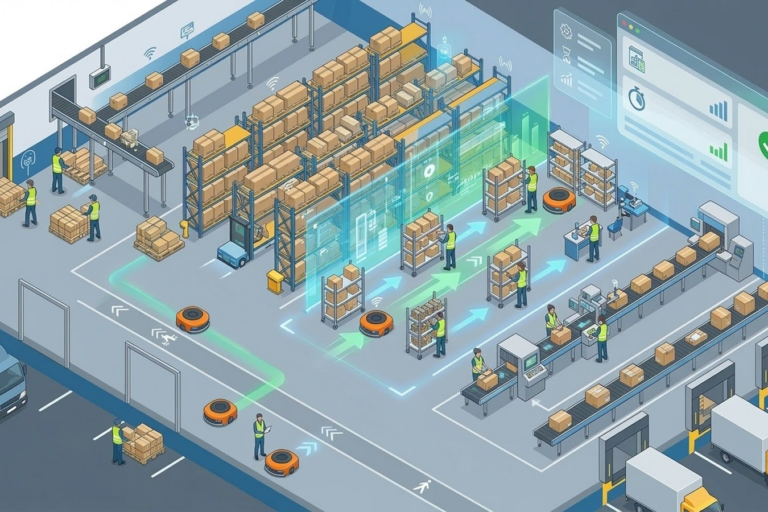
The layout of aisles determines how people and equipment move through your facility. Smart designs implement one-way traffic flows to prevent collisions between forklifts and pickers, wider primary aisles for equipment movement with narrower secondary aisles for hand-picking zones, clearly marked pedestrian walkways to ensure worker safety, and dedicated inbound and outbound docking zones to separate receiving from shipping traffic.
Vertical Space Utilization
Most warehouses focus entirely on floor space and completely neglect ceiling height. Investing in tall racking systems, mezzanine levels, and vertical lift modules can effectively multiply your storage capacity without expanding your footprint. The right racking configuration, whether selective, drive-in, push-back, or pallet flow, depends on your inventory profile and picking strategy. Going vertical is one of the fastest ways to unlock capacity you already own.
Dedicated Functional Zones
Segmenting your warehouse into clearly defined zones reduces confusion and creates accountability. A well-designed facility typically includes a receiving and inspection zone, a bulk storage zone, an active picking zone, a packing and quality check zone, a shipping and staging zone, and a returns processing zone. Each zone should be sized according to throughput, not simply available space, and positioned to support a logical, linear workflow from receiving to shipping.
3. Technology That Amplifies Layout Efficiency
A smart layout is the foundation, but technology multiplies its impact. At URSA Handling Services, we leverage advanced logistics solutions and state-of-the-art technology to optimize supply chain operations for our clients. Several tools integrate seamlessly with your physical design to drive further gains.
A Warehouse Management System (WMS) assigns optimal storage locations dynamically, generates efficient pick routes, and provides real-time inventory visibility across your entire facility. Barcode and RFID scanning deliver accurate, fast product tracking that reduces errors and speeds up receiving and picking cycles. Pick-to-light and voice-directed picking technologies guide workers to the right locations, reducing training time and improving accuracy. Automated conveyor and sortation systems eliminate manual transport bottlenecks for high-volume operations. And slotting optimization software continuously analyzes your order data and recommends adjustments as velocity patterns shift with your business.
4. How Layout Design Impacts Key Efficiency Metrics
The business case for investing in layout design is measurable. Velocity-based slotting alone can cut pick time by up to 30%, directly reducing order cycle times. Optimized traffic flow reduces the labor hours needed to process the same volume of orders, lowering your cost per shipment. Proper racking and vertical utilization strategies can add 20 to 40% more usable storage capacity without a single square foot of new construction. Logical zoning brings down picking error rates and the costly returns that come with them. Clear zone structures also shorten new hire onboarding time significantly. And defined, well-marked pathways reduce accident risk, keeping your team safe and your operations compliant.
5. Common Layout Mistakes to Avoid
Even well-intentioned warehouse redesigns can fall short if certain pitfalls are not addressed.
Designing for current volume only is one of the most common errors. A layout that works perfectly today may buckle under seasonal peaks or business growth. Always build in flexibility and scalable storage options. Neglecting the dock area is equally costly. The receiving and shipping dock is the first and last touchpoint for every product, and inadequate staging space here creates ripple effects throughout the entire facility.
Ignoring ergonomics increases injury risk and slows workers down. Placing heavy or bulky items at awkward heights is both a safety hazard and a productivity drain. Treating the layout as permanent is another trap. Inventory profiles change, and a layout should be reviewed and adjusted at a minimum once per year using data from your WMS. Finally, overlooking safety compliance is never acceptable. Every layout must meet fire code, emergency egress requirements, and OSHA guidelines. A safe layout and an efficient layout are not in conflict. They are the same thing done right.
6. When Is the Right Time to Redesign Your Warehouse Layout?
Not every warehouse needs a complete overhaul, but there are clear signals that a layout review is overdue. If order fulfillment times are consistently missing targets, if your team spends more time searching for products than picking them, if customer complaints about order accuracy are rising, or if you are adding headcount without seeing proportional output gains, these are all signs your layout is working against you.
You should also consider a redesign when you are planning to introduce new product lines, significantly change your SKU count, or implement a new WMS or automation system. In any of these scenarios, the return on a professional layout assessment is almost always significant.
7. How URSA Handling Services Supports Warehouse Efficiency
At URSA Handling Services, we are committed to providing top-tier logistics and handling solutions tailored to your business needs. Our secure warehousing facilities are strategically located, fully equipped with climate control, and supported by robust inventory management systems designed to keep your supply chain running smoothly.
We take a data-driven, operations-first approach to warehouse layout optimization. We start by understanding your business, including your order profiles, SKU velocity, equipment, team size, and growth trajectory, before making a single recommendation. Our operational audit assesses your current layout, workflows, and pain points through both on-site observation and data analysis. From there, we use your current and projected volume data to model layout scenarios that optimize flow and storage density. We develop a velocity-based slotting plan aligned with your order fulfillment patterns and ensure your physical layout works in harmony with your WMS, automation tools, and future technology roadmap. Throughout implementation, we guide your team with minimal disruption to daily operations.
The result is a warehouse that works smarter, not just harder.
Conclusion: Layout Is Strategy
Your warehouse layout is not just a logistical concern. It is a strategic asset. The difference between a reactive, inefficient facility and a high-performing operation often comes down to how thoughtfully the physical space has been designed and continuously optimized.
Smart layout design reduces costs, accelerates fulfillment, improves safety, and positions your business to grow without operational chaos. For companies that rely on their warehouse to deliver customer promises, investing in the right layout is not optional. It is essential.
Ready to assess your current warehouse layout? Contact URSA Handling Services today at info@ursaservice.com or visit us at ursaservice.com to schedule your consultation.