
Last-Mile Delivery Challenges and Solutions in Modern Logistics
Introduction
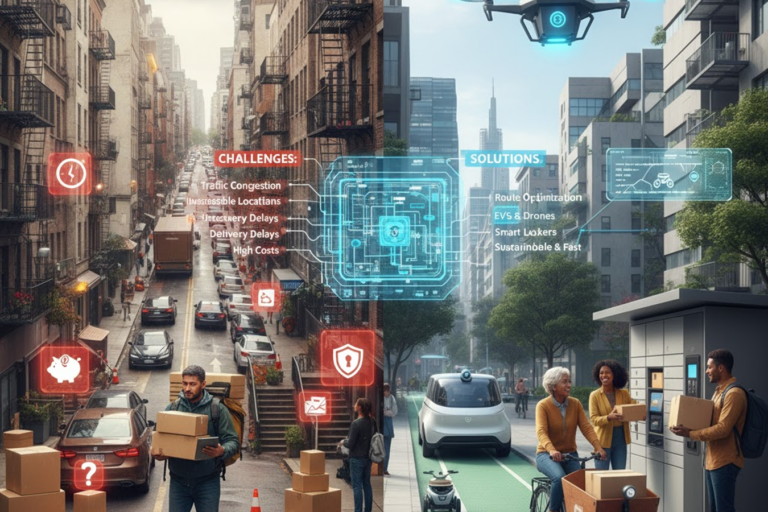
A shipment can travel thousands of kilometers smoothly and still fail at the final step. This final step is known as the last mile. In modern supply chains, the last mile is often the most complex, expensive, and customer-visible stage of logistics.
For logistics providers and businesses alike, last-mile performance defines customer experience. Delays, missed deliveries, or damaged goods at this stage can erase all the effort invested earlier. This is why last mile delivery solutions have become a major focus in modern logistics.
In this blog, we explore the most common last-mile delivery challenges and share practical, experience-based solutions that help logistics operations stay efficient, reliable, and scalable.
What Is Last-Mile Delivery?
Last-mile delivery refers to the final movement of goods from a warehouse, distribution center, or terminal to the end customer. This could be a retail outlet, business location, or residential address.
While it is the shortest physical distance in the supply chain, it is often the most difficult to manage due to congestion, time sensitivity, and customer expectations.
Why Last-Mile Delivery Is So Challenging
Modern logistics has changed dramatically:
Customers expect faster deliveries
Urban areas are more congested
Delivery windows are tighter
Costs are under constant pressure
As a result, the last mile now accounts for a significant portion of total logistics cost and complexity.
Common Last-Mile Delivery Challenges
1. Urban Congestion and Traffic Delays
The Challenge
Busy city roads, limited parking, and restricted delivery hours slow down deliveries and increase fuel and labor costs.
The Solution
Plan deliveries during off-peak hours
Use route optimization and zone-based planning
Position warehouses closer to delivery areas
Smarter planning reduces wasted time on the road.
2. High Cost Per Delivery
The Challenge
The last mile often costs more per shipment than long-haul transport due to small drop sizes and frequent stops.
The Solution
Consolidate deliveries by area
Use shared delivery routes
Improve load planning from warehouses
Efficient grouping lowers cost per delivery.
3. Failed Delivery Attempts
The Challenge
Missed deliveries due to customer unavailability increase cost and delay completion.
The Solution
Confirm delivery windows in advance
Provide delivery notifications
Offer flexible delivery options
Communication reduces repeat attempts.
4. Limited Visibility and Tracking
The Challenge
Without real-time updates, delays are discovered too late, affecting customer satisfaction.
The Solution
Use tracking and reporting systems
Share delivery status with customers
Monitor performance at driver and route level
Visibility enables proactive action.
5. Last-Mile Capacity Constraints
The Challenge
Peak seasons and sudden demand spikes overwhelm delivery capacity.
The Solution
Maintain flexible delivery fleets
Partner with local transport providers
Use temporary capacity during peak periods
Scalable solutions prevent service breakdowns.
6. Warehouse and Dispatch Inefficiencies
The Challenge
Poor warehouse coordination causes late dispatches, affecting delivery schedules.
The Solution
Align picking and dispatch with delivery routes
Prepare loads based on delivery sequence
Reduce handling delays at dispatch
Strong warehouse coordination supports smooth last-mile execution.
7. Customer Expectations and Service Pressure
The Challenge
Customers expect speed, accuracy, and communication at all times.
The Solution
Set realistic delivery commitments
Focus on reliability, not just speed
Train delivery teams for customer interaction
Consistency builds trust.
Comparison Table: Last-Mile Challenges and Solutions
| Challenge | Impact | Practical Solution |
|---|---|---|
| Traffic congestion | Delivery delays | Route and time optimization |
| High delivery cost | Reduced margins | Consolidation and planning |
| Failed deliveries | Extra cost | Customer communication |
| Poor visibility | Low satisfaction | Tracking systems |
| Capacity limits | Missed commitments | Flexible resources |
| Dispatch delays | Late deliveries | Warehouse alignment |
| Service pressure | Complaints | Realistic promises |
The Role of Warehousing in Last-Mile Success
Warehouses are the starting point of last-mile delivery.
Optimized warehouses:
Prepare orders by delivery zone
Reduce loading time
Improve dispatch accuracy
Support faster turnaround
Strong last-mile delivery solutions always start with efficient warehousing.
Real-World Operational Insight
In one distribution operation, delivery delays were blamed on drivers. A deeper review showed the real issue was late dispatch from the warehouse.
Changes Implemented
Orders were picked by delivery route
Dispatch schedules aligned with driver availability
Loading sequences were standardized
Results
On-time delivery improved significantly
Driver idle time reduced
Customer complaints dropped
This showed that last-mile problems are often system problems, not people problems.
How URSA Supports Effective Last-Mile Delivery
URSA Handling Services focuses on creating reliable last-mile delivery solutions by strengthening the link between warehousing, handling, and distribution.
Key strengths include:
Efficient warehouse preparation and dispatch
Secure cargo handling before delivery
Coordination with local delivery networks
Focus on reliability and service quality
By addressing last-mile challenges holistically, URSA helps businesses deliver with confidence.
Best Practices for Strong Last-Mile Delivery Solutions
Plan routes and delivery zones carefully
Align warehouse operations with delivery schedules
Use data to monitor performance
Communicate clearly with customers
Build flexibility into capacity planning
Review delivery outcomes regularly
Continuous improvement keeps last-mile operations competitive.
Why Last-Mile Excellence Creates Competitive Advantage
In modern logistics, customers remember the final delivery experience more than the shipping process.
Strong last-mile delivery solutions:
Improve customer satisfaction
Reduce operational cost
Strengthen brand reputation
Support long-term growth
Last-mile excellence is no longer optional.
Conclusion
The last mile is where logistics meets the customer. Challenges such as congestion, cost pressure, and rising expectations make this stage complex, but not unmanageable.
With the right planning, coordination, and execution, businesses can overcome last-mile delivery challenges and turn them into strengths. Last mile delivery solutions that integrate warehousing, handling, and distribution create reliable, scalable logistics operations.
Call to Action
Is your last-mile delivery supporting your customer experience or damaging it?
If you want to reduce delays, control costs, and improve delivery reliability, it is time to strengthen your last-mile strategy.
Contact URSA Handling Services to explore last-mile delivery solutions designed for modern logistics demands.