
The Role of Warehousing in Managing Post-Conflict Supply Chain Recovery
Introduction
Global conflicts disrupt supply chains in ways that extend far beyond the immediate region. Shipping delays, route diversions, fluctuating fuel costs, and unpredictable delivery schedules create instability across logistics networks. Even after a ceasefire or de-escalation, supply chains do not return to normal overnight.
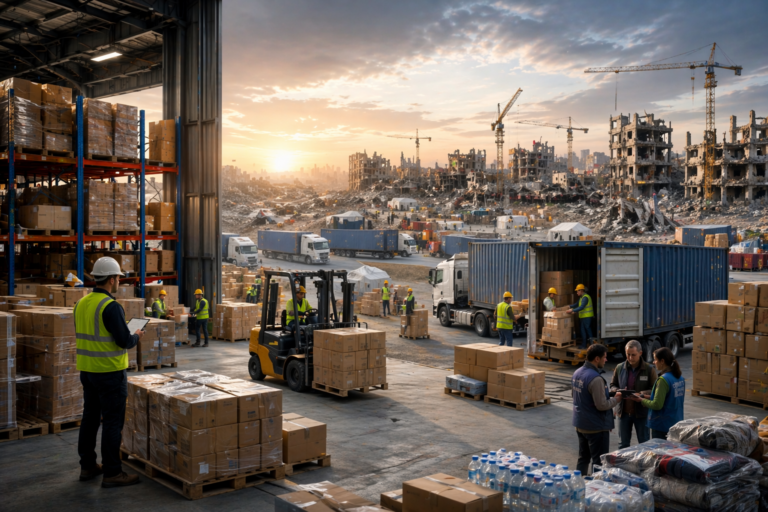
This is where warehousing plays a critical role. In the post-conflict phase, warehouses act as stabilizing points that help businesses regain control over inventory, manage delayed shipments, and restore operational flow. Without strong warehousing support, recovery becomes slower and more unpredictable.
In this blog, we explore how warehousing supports supply chain recovery after global disruptions and why it is essential for maintaining business continuity.
Understanding Post-Conflict Supply Chain Challenges
After a conflict or disruption, supply chains face multiple challenges:
- Backlogs of delayed shipments
- Irregular cargo arrivals
- Increased inventory pressure
- Uncertain delivery schedules
These challenges do not resolve immediately. Instead, they shift pressure toward storage and distribution systems.
Why Warehousing Becomes Critical During Recovery
Warehouses act as control points in uncertain conditions.
They help businesses:
- Absorb sudden increases in inventory
- Manage delayed shipments
- Stabilize supply chain flow
Without warehousing support, businesses struggle to handle recovery efficiently.
Key Roles of Warehousing in Supply Chain Recovery
1. Managing Backlogs of Inventory
After disruptions, shipments often arrive in batches rather than a steady flow.
Warehousing helps by:
- Storing excess inventory safely
- Organizing goods for quick access
- Preventing congestion in distribution channels
This ensures that backlog does not turn into operational chaos.
2. Stabilizing Inventory Flow
Irregular supply can disrupt production and sales.
Warehouses provide:
- Buffer storage to smooth supply fluctuations
- Controlled release of goods based on demand
- Better inventory planning
Stability allows businesses to operate more confidently.
3. Supporting Flexible Distribution
During recovery, delivery schedules may change frequently.
Warehousing enables:
- Re-routing of goods
- Adjustments in dispatch timing
- Faster response to market demand
Flexibility improves responsiveness.
4. Reducing Pressure on Transport Systems
When transport systems are overloaded, warehouses act as holding points.
This reduces:
- Immediate delivery pressure
- Transport bottlenecks
- Risk of missed deliveries
Warehousing balances the system.
5. Protecting Cargo During Uncertainty
In unstable conditions, cargo safety becomes more important.
Warehouses ensure:
- Secure storage environments
- Proper handling practices
- Protection from damage or loss
Safe storage protects business value.
The Shift from Storage to Strategic Control
In post-conflict scenarios, warehouses are no longer just storage facilities.
They become:
- Inventory control centers
- Distribution planning hubs
- Risk management points
This shift highlights the importance of structured warehouse operations.
Challenges Warehouses Face During Recovery
Warehousing operations also face pressure during recovery phases:
- Limited storage capacity
- Increased handling volume
- Need for faster processing
- Higher coordination demands
Without proper planning, these challenges can reduce efficiency.
How Warehouses Can Adapt to Recovery Conditions
1. Optimize Space Utilization
Efficient storage becomes critical.
Warehouses should:
- Reorganize storage layouts
- Use vertical space effectively
- Prioritize high-demand inventory
Better space management reduces congestion.
2. Improve Inventory Visibility
Real-time visibility helps manage uncertainty.
This includes:
- Tracking incoming shipments
- Monitoring stock levels
- Identifying slow-moving goods
Visibility supports better decision-making.
3. Strengthen Coordination with Logistics Partners
Warehouses must stay aligned with transport and distribution teams.
Coordination helps:
- Plan for incoming cargo
- Adjust dispatch schedules
- Reduce delays
Communication improves efficiency.
4. Maintain Structured Handling Processes
Even during high pressure, processes must remain consistent.
This ensures:
- Safe cargo handling
- Reduced errors
- Controlled workflow
Discipline maintains performance.
Comparison: Pre-Conflict vs Post-Conflict Warehousing
| Area | Pre-Conflict | Post-Conflict |
|---|---|---|
| Inventory flow | Predictable | Irregular |
| Storage demand | Stable | Increased |
| Delivery schedules | Fixed | Flexible |
| Operational pressure | Moderate | High |
| Role of warehouse | Storage | Strategic control |
Warehousing becomes more important during recovery.
Real-World Operational Insight
In one scenario, after a period of disruption, shipments that were delayed for weeks began arriving simultaneously.
Initial impact:
- Warehouse capacity was stretched
- Dispatch operations slowed
- Inventory tracking became difficult
After implementing structured warehousing practices:
- Storage zones were reorganized
- Inventory was categorized by priority
- Dispatch schedules were aligned
Operations stabilized without expanding the facility.
Why Flexibility Defines Successful Recovery
Rigid systems fail during recovery phases.
Flexible warehouses:
- Adjust to changing volumes
- Support dynamic distribution
- Maintain operational stability
Flexibility ensures faster recovery.
How URSA Supports Post-Conflict Recovery
URSA Handling Services understands the challenges businesses face during supply chain recovery.
URSA supports clients by:
- Managing high-volume cargo efficiently
- Maintaining structured storage and handling
- Optimizing warehouse flow
- Supporting coordination between storage and distribution
By focusing on adaptability and operational discipline, URSA helps businesses regain control during uncertain periods.
Best Practices for Businesses
To manage post-conflict recovery effectively:
- Plan for sudden inventory increases
- Maintain buffer storage capacity
- Improve communication with logistics partners
- Monitor warehouse performance regularly
- Review processes and adjust quickly
Prepared businesses recover faster.
Long-Term Importance of Warehousing
Even after recovery, warehousing continues to play a key role in maintaining stability.
Strong warehouse systems:
- Support consistent supply
- Reduce future disruption impact
- Improve overall supply chain resilience
Warehousing becomes a long-term strategic asset.
Conclusion
Post-conflict supply chain recovery is complex and requires strong operational support. Warehousing plays a central role in stabilizing inventory, managing delays, and restoring flow across logistics networks.
By acting as buffer zones and control points, warehouses help businesses transition from disruption to stability. With structured processes, efficient storage, and strong coordination, warehousing becomes a powerful tool for recovery.
With experienced partners like URSA Handling Services, businesses can navigate uncertainty and rebuild supply chain performance with confidence.
Call to Action
Is your business facing challenges in managing supply chain recovery?
If you want to stabilize your operations and improve warehouse efficiency during uncertain times, it is time to strengthen your warehousing strategy.
Contact URSA Handling Services today to support your recovery and build a more resilient supply chain.