Warehouse Storage vs Warehouse Optimization: What Businesses Get Wrong.
Introduction
Many businesses believe that having a warehouse means they have solved their logistics challenge. As long as goods are stored safely, operations must be running efficiently, right? Not exactly.
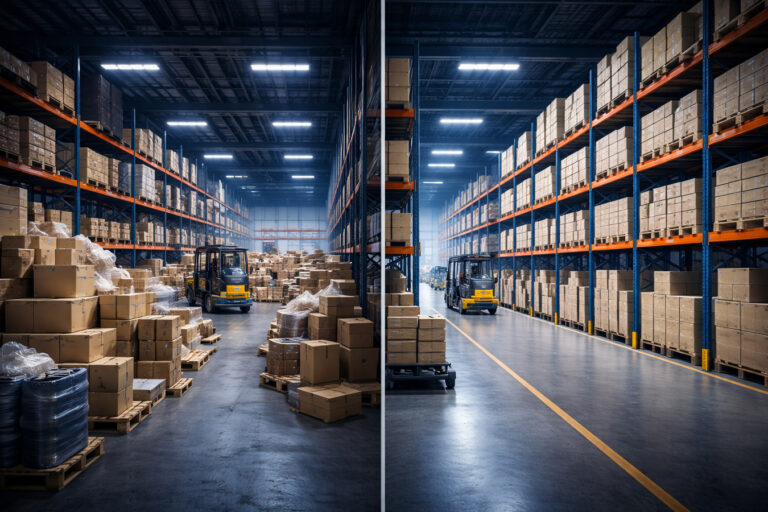
There is a major difference between simple warehouse storage and true warehouse optimization. Storage is about placing goods inside a facility. Optimization is about designing that facility to improve speed, accuracy, cost control, and overall supply chain performance.
This misunderstanding is one of the biggest operational mistakes businesses make. In this blog, we explore what companies often get wrong and how shifting from basic storage to strategic optimization can transform warehouse performance.
Understanding Warehouse Storage
Warehouse storage focuses on space. Its primary goal is to keep inventory secure until it is needed.
Storage typically includes:
Receiving goods
Placing items on racks or pallets
Keeping them organized
Dispatching when orders arrive
While storage is necessary, it does not automatically ensure efficiency.
A warehouse can be full, secure, and well-lit but still operate inefficiently.
What Is Warehouse Optimization?
Warehouse optimization goes beyond storage. It focuses on improving how goods move through the facility.
Warehouse optimization includes:
Smart layout design
Slotting products based on demand
Reducing travel time for pickers
Improving dispatch speed
Aligning warehouse flow with supply chain goals
Optimization treats the warehouse as a performance engine, not just a storage unit.
What Businesses Often Get Wrong
1. Prioritizing Space Over Flow
Many companies focus on maximizing storage capacity. They pack more racks into limited space without considering movement flow.
The result:
Congested aisles
Slower picking times
Increased handling errors
More storage does not always mean better performance.
2. Ignoring Product Velocity
Fast-moving products should be placed closer to dispatch areas. Slow-moving items can be stored deeper inside.
Businesses often fail to adjust layout based on demand patterns. This increases unnecessary travel time and labor cost.
Optimization aligns product placement with movement frequency.
3. Treating Warehousing as Static
Storage thinking assumes inventory simply sits until needed.
Optimization thinking asks:
How quickly can orders be processed?
How smoothly does cargo move?
Where are the bottlenecks?
Warehouses should evolve as business volumes change.
4. Lack of Data and Performance Tracking
Without measuring:
Order processing time
Dwell time
Picking accuracy
Space utilization
Businesses cannot identify inefficiencies.
Optimization requires visibility and continuous improvement.
Storage vs Optimization: A Clear Comparison
| Aspect | Warehouse Storage | Warehouse Optimization |
|---|---|---|
| Focus | Space usage | Performance improvement |
| Layout | Static | Flow-based |
| Inventory placement | Random or basic | Demand-driven |
| Goal | Keep goods safe | Improve speed and efficiency |
| Impact on the supply chain | Limited | High |
The difference is strategic thinking.
Why Warehouse Optimization Matters Today
Modern supply chains demand:
Faster deliveries
Lower operational costs
High order accuracy
Scalable infrastructure
Basic storage cannot meet these expectations.
Warehouse optimization directly supports:
Reduced handling time
Faster dispatch
Improved customer satisfaction
Better cost control
Optimization strengthens the entire supply chain.
How Poor Warehouse Design Impacts Operations
When warehouses are not optimized:
Orders take longer to fulfill
Labor productivity declines
Congestion increases
Cargo damage risk rises
These problems affect delivery performance and customer trust.
The Role of Layout in Optimization
Layout is the foundation of warehouse efficiency.
Optimized warehouses:
Separate receiving and dispatch zones
Maintain clear movement paths
Place high-demand items strategically
Reduce cross-traffic between teams
Layout determines how efficiently goods move.
The Importance of Process Standardization
Optimization also depends on structured processes.
Best practices include:
Defined receiving procedures
Standard picking routes
Clear dispatch protocols
Regular performance reviews
Consistency reduces errors and improves speed.
Real-World Insight
In one warehouse, management believed they had enough storage capacity. However, order fulfillment times were increasing.
After reviewing operations:
High-demand items were stored far from dispatch
Aisles were overcrowded
Picking routes were inefficient
By reorganizing layout and optimizing product placement:
Picking speed improved
Order accuracy increased
Labor cost reduced
The facility did not expand. It simply shifted from storage thinking to optimization thinking.
How Warehouse Optimization Supports Growth
As businesses grow, warehouse pressure increases.
Optimization allows warehouses to:
Handle higher volumes
Adapt to seasonal peaks
Support faster delivery commitments
Scale without immediate expansion
Optimization protects long-term performance.
How URSA Supports Warehouse Optimization
URSA Handling Services focuses on more than storage. The goal is to create efficient warehouse environments that support supply chain performance.
URSA emphasizes:
Structured cargo flow
Strategic layout planning
Secure handling practices
Continuous operational improvement
By combining storage with optimization, URSA helps businesses strengthen logistics reliability.
Best Practices to Shift from Storage to Optimization
To improve warehouse performance:
Analyze product demand patterns
Redesign layout based on flow
Reduce unnecessary handling
Monitor performance metrics
Train teams on structured processes
Small improvements create measurable impact.
Why Optimization Is a Competitive Advantage
Businesses that optimize warehouses:
Deliver faster
Reduce operating costs
Improve order accuracy
Strengthen customer satisfaction
In competitive markets, efficiency differentiates leaders from average performers.
Conclusion
Warehouse storage is essential, but it is not enough. Businesses that treat warehousing as simple storage often struggle with inefficiency, delays, and rising costs.
Warehouse optimization transforms storage facilities into performance drivers. By focusing on flow, layout, processes, and continuous improvement, companies can unlock greater speed, accuracy, and reliability.
For organizations looking to strengthen logistics operations, the shift from storage to optimization is not optional. It is strategic.
Call to Action
Is your warehouse operating as a storage space or a performance engine?
If you want to improve efficiency, reduce costs, and strengthen your supply chain, it is time to focus on optimization.
Contact URSA Handling Services to learn how structured warehouse solutions can enhance your operational performance.